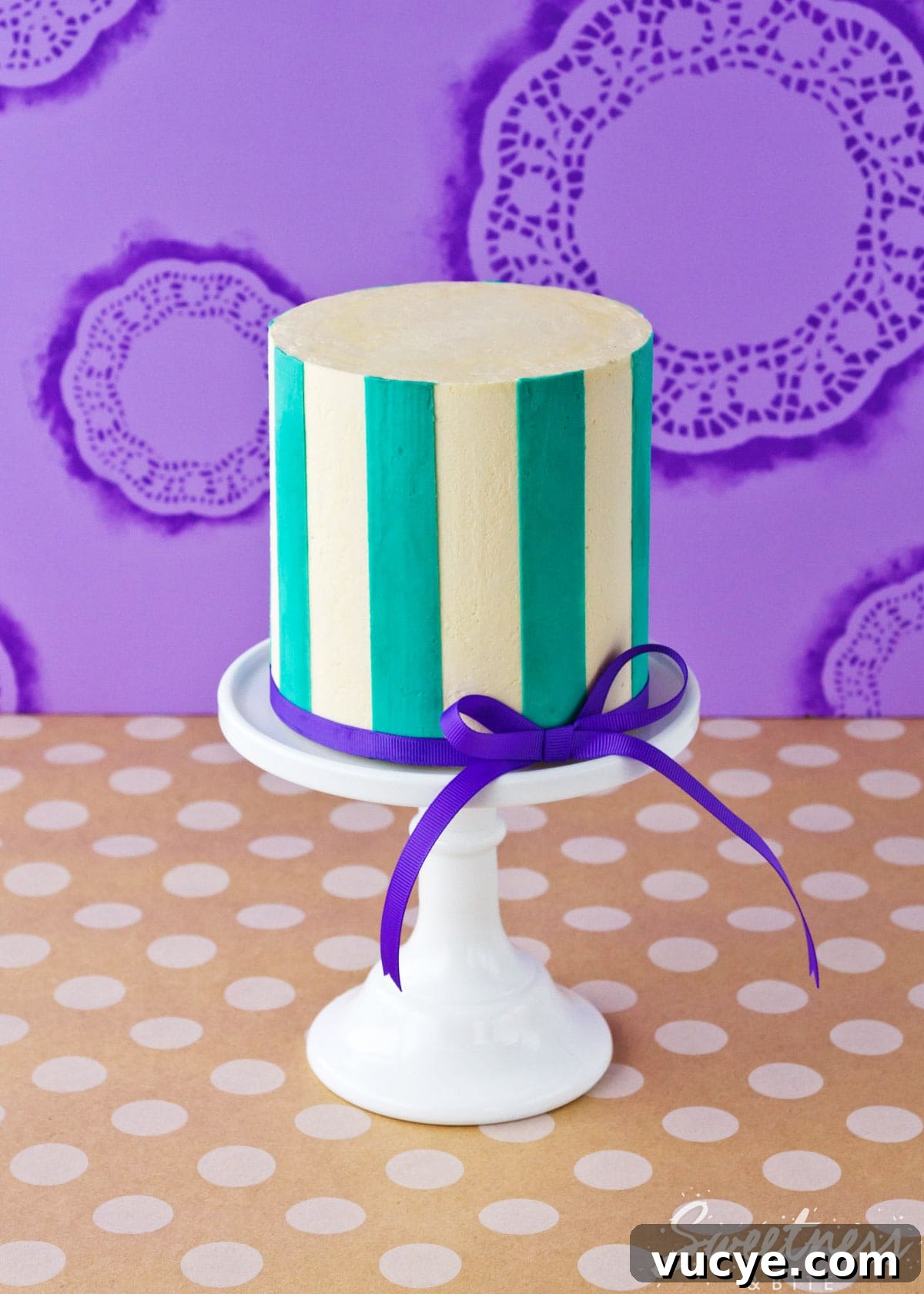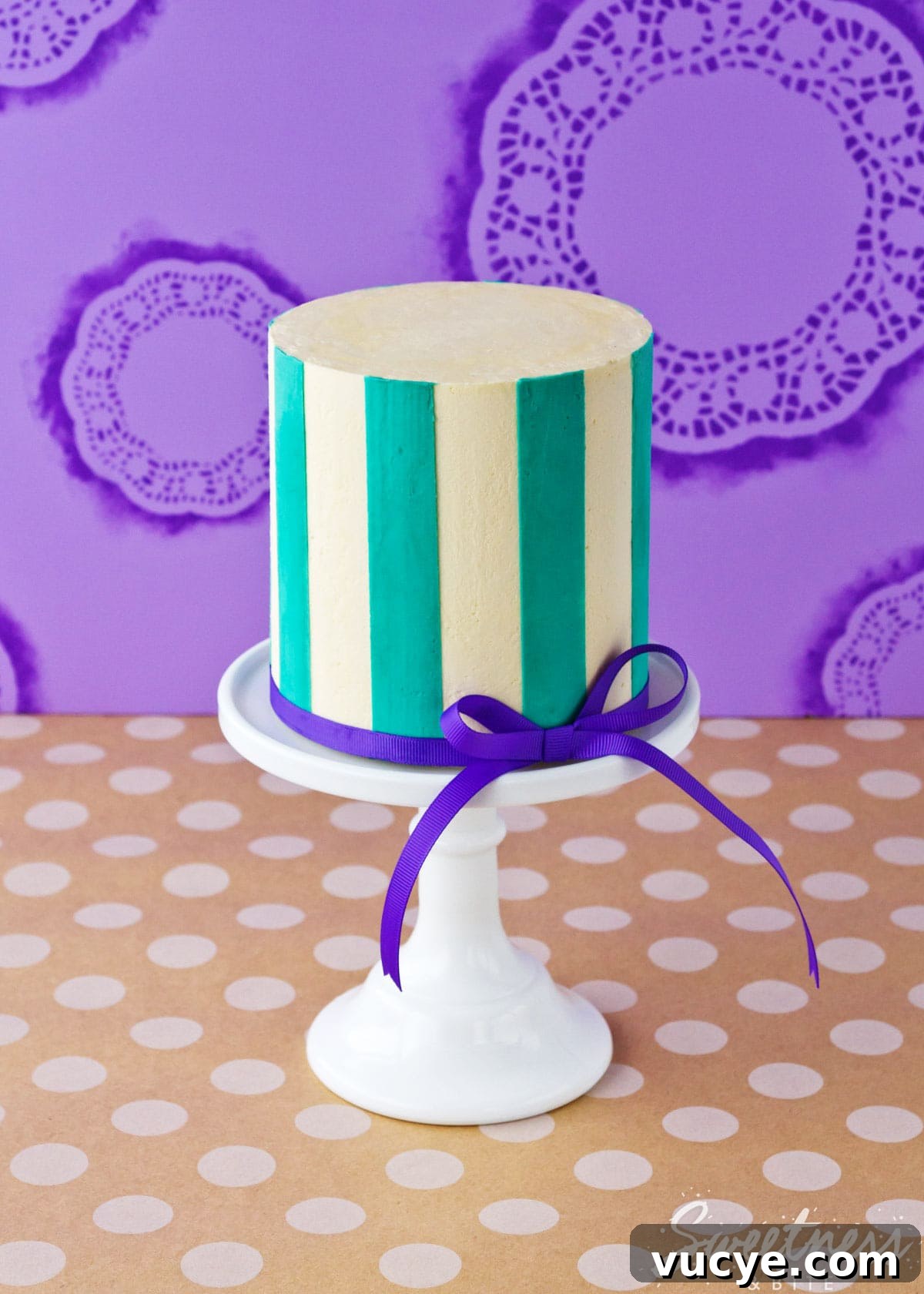
 Today we move on to Part Two of the buttercream stripes tutorial — the part where we actually add stripes to the smooth buttercream-covered cake you prepared in Part One. If you haven’t followed Part One, check it first for tips on achieving straight sides and a smooth finish, since a few steps there are important for what follows. Vertical stripes are the simplest, so we’re starting with those before tackling diagonal stripes later. The method I use to space stripes evenly may look elaborate, but it keeps everything neat; you can use a tape measure instead, though that risks leaving marks or producing uneven stripes. If I can do this, so can you. When we left off, the cake was iced and chilled, ready for stripes. You can prepare guides while the cake chills, or do everything beforehand. Let’s get started.
Vertical Buttercream Stripes
*
What you’ll need:
Your buttercream-covered cake (mine was 5″ tall, 5″ round)
Buttercream (a few heaped tablespoons)
Gel food colouring
Waxed paper and/or baking paper
Plain white paper, pencil, ruler, protractor, cutting mat and blade/scalpel
Turntable
Setup board or cake board
Spatula/palette knife and a right-angled scraper
Vegetable shortening (Crisco)
The waxed paper circle you cut in Part One (cut carefully — if it’s too big it will cause problems)
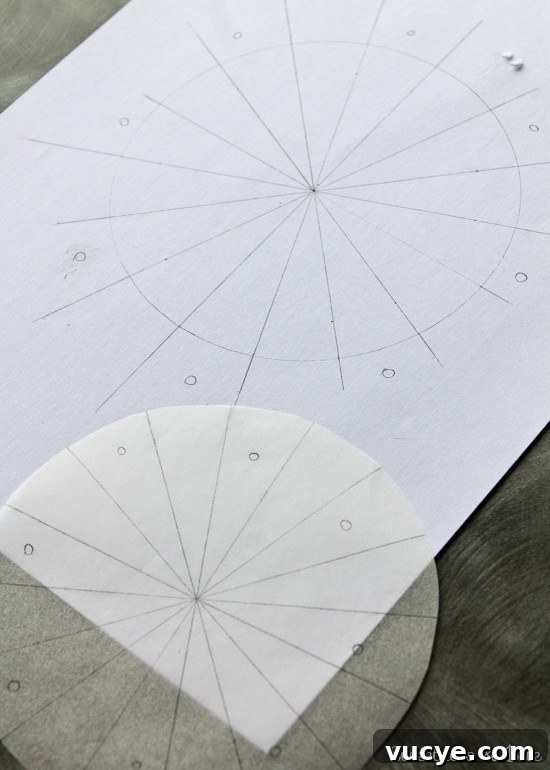
First, make guides for placing the stripes. Instead of marking the iced cake directly, create a top and bottom guide on paper. Draw a “pizza” on plain paper — each slice marks a stripe. Trace that pattern onto a waxed paper circle that will sit on top of the cake. When the top and bottom guides line up, applying strips becomes a simple alignment process.
Use the paper you traced your cake board on in Part One. Calculate the cake’s circumference (circumference = π × diameter). For a 5″ cake the circumference is about 15.707″, which I rounded to 16″. Decide your stripe width so the circumference divides evenly into an even number of stripes, ensuring alternating colors. I chose 1″ stripes, giving sixteen stripes for a 16″ circumference. To find the angle for each slice, divide 360° by the number of stripes: 360 ÷ 16 = 22.5°. This is the angle you’ll mark with a protractor.
On the paper with the circle outline, draw a line from the center outward and extend it slightly past the edge so it’s visible when the cake sits on it. Place the protractor on the center and mark the angle (22.5° in my case). Draw a line through that mark from the center to the edge. Move the protractor to the new line and repeat until the circle is divided into equal slices. Mark every other section so you know which stripes will be colored. If the last slice is off by a millimeter or two it’s fine; larger errors mean re-checking your measurements.
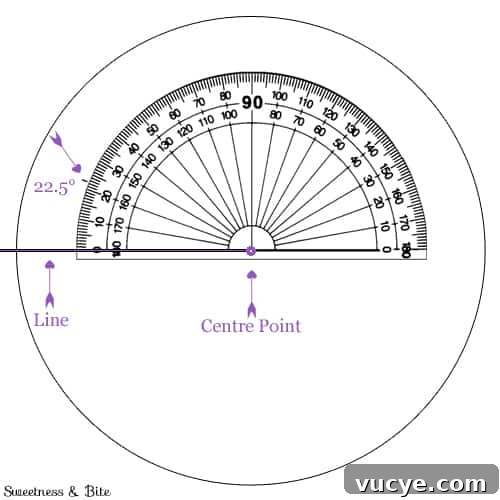 Once the paper guide is complete, place the waxed paper circle (waxed side down) over it and trace the lines onto the waxed paper. Mark alternate sections as on the bottom guide. Now you have two templates: the large paper guide for the base and the waxed paper circle for the top.
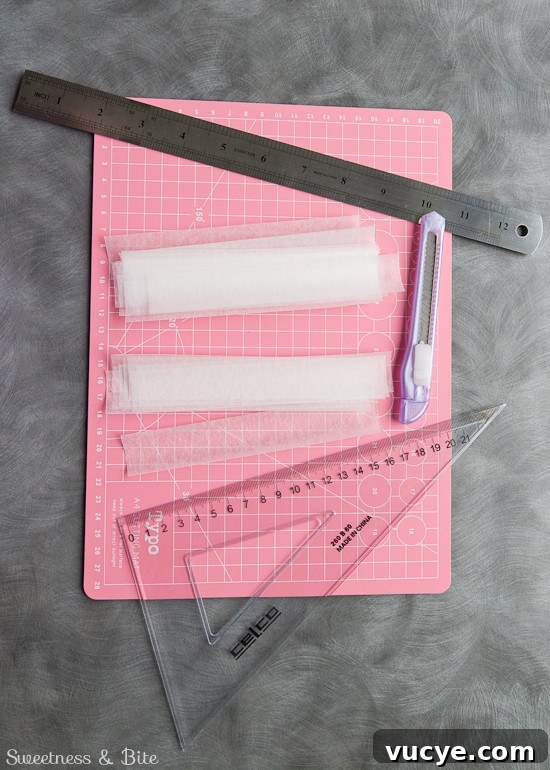
Next, use a straight edge or triangle to trim a piece of baking or waxed paper into straight strips the width of your chosen stripe and about 1″ taller than the cake’s height. If you don’t know the final height until after icing, measure then. You need half as many paper strips as stripes (for alternating color and blank sections): for 16 stripes you’ll need 8 strips. Cut a few extras just in case.
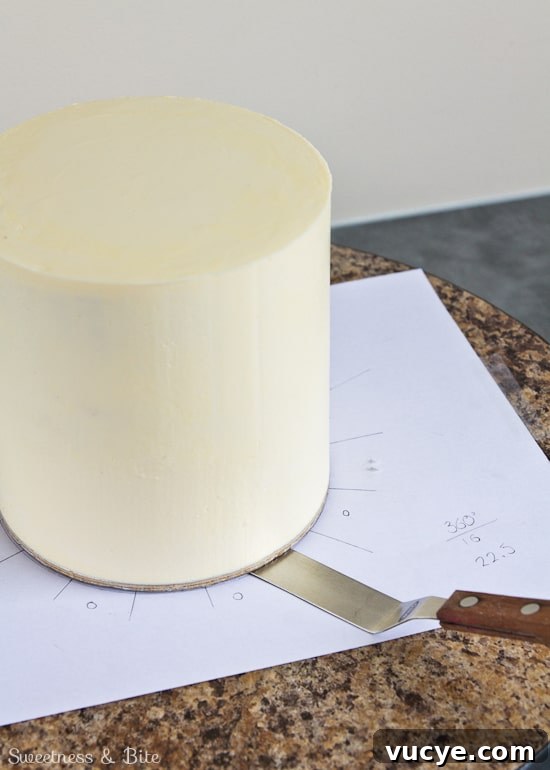
Tape the paper guide to your turntable and place the chilled cake on top. Use a right-angled straight edge to align with one of the section lines on the bottom guide and mark that line lightly on the buttercream.
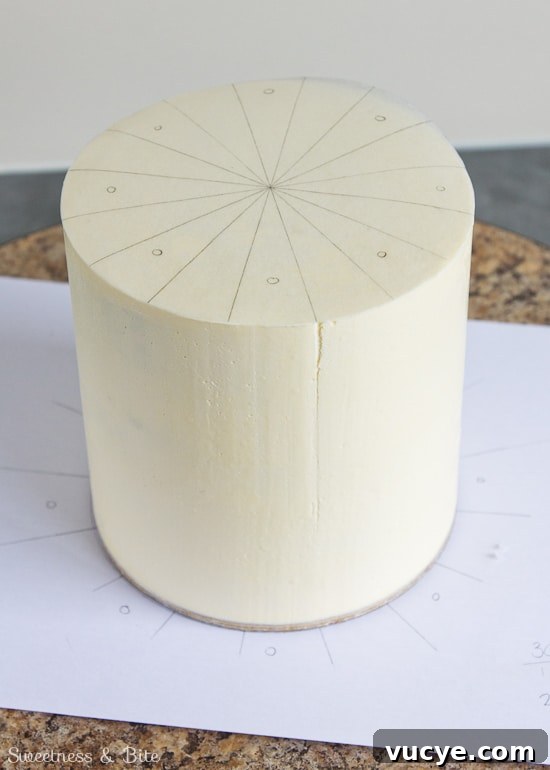
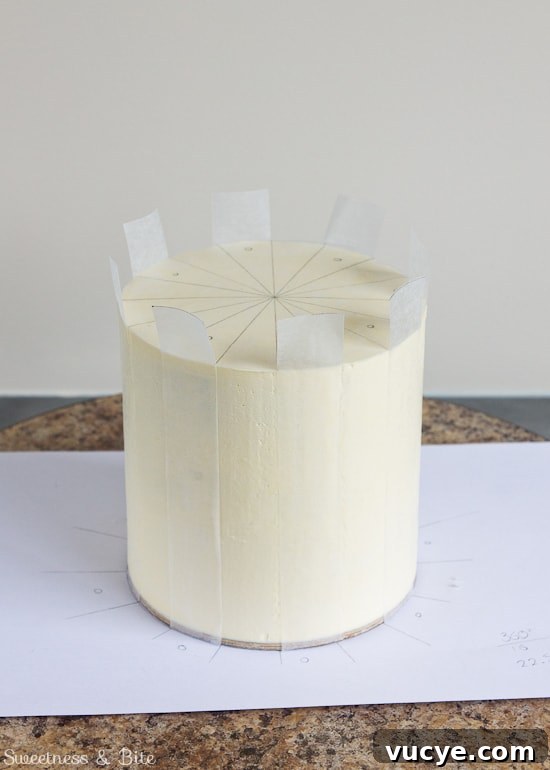
 Take the waxed paper circle and apply a thin layer of shortening to the waxed side. Lay it shortening-side down on the cake, aligning a marked top section with the corresponding mark you made on the cake. Make sure the waxed circle sits flush; if it overhangs, trim or remake it so the paper won’t lift the buttercream or leave gaps.
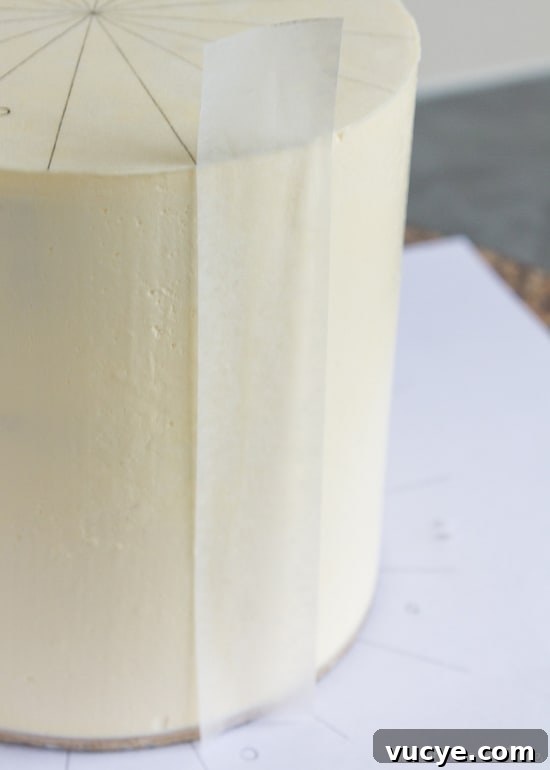
Lightly grease each paper strip with Crisco — I found using my finger gives the best control and ensures even coverage. Greasing prevents colored buttercream from sticking to the paper when you remove the strips. Line each strip up on the cake, starting at the bottom edge, then aligning the top. Gently press the paper against the cake; don’t worry if the buttercream next to the strip gets a small mark — that area will be covered with color.
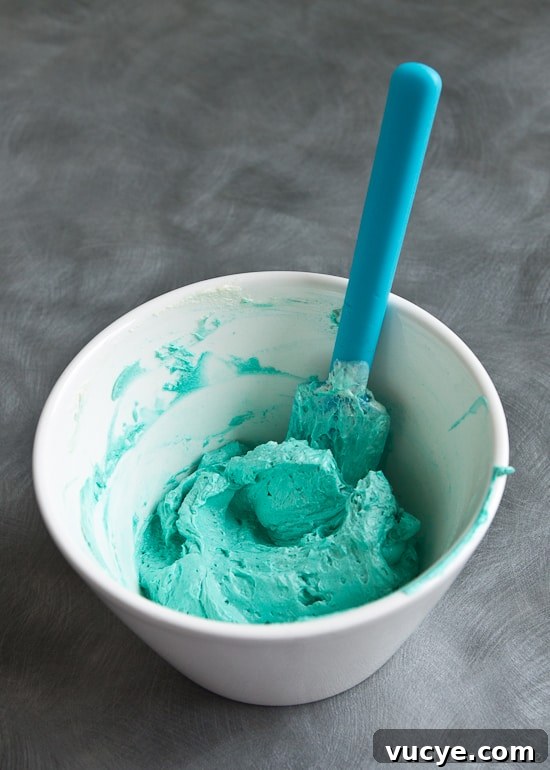
Mix two heaped tablespoons of buttercream with gel color until smooth; keep a little uncolored icing aside in case you need to soften the tone. Beat the buttercream well to remove air and achieve the consistency of thick paint. For my turquoise I used Americolor turquoise plus a drop of sky blue. Darker colors may deepen over time, so be aware of that.
Using a small offset spatula, apply a thin layer of colored buttercream between the paper strips. Before filling each section, press the paper strip edges firmly to reduce bleeding. Use an up-and-down motion with the spatula — avoid sideways scraping — and be gentle near the top edge to prevent buttercream from getting under the top waxed circle.
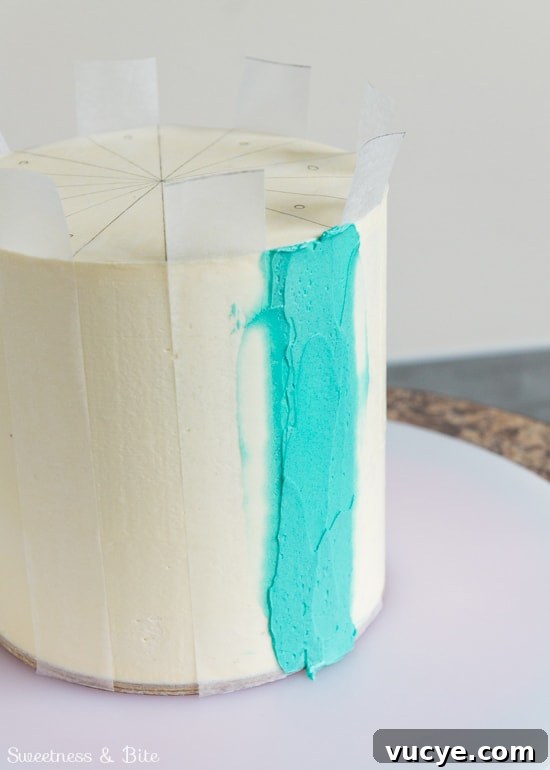
Work all the way around the cake, pressing strip edges before filling each stripe.
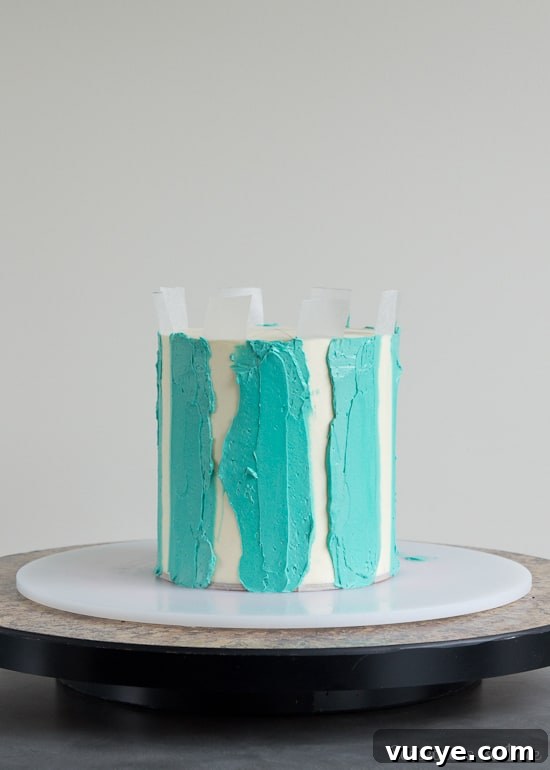
When every stripe has a rough layer, warm your straight-angled scraper under warm water, dry it, and gently scrape away excess buttercream. Take several light passes rather than trying to remove everything in one go. Clean and dry the scraper after each pass. If you take off too much color, add a little more buttercream and resmooth. I aimed for tidy stripes but left a few small imperfections due to time constraints.
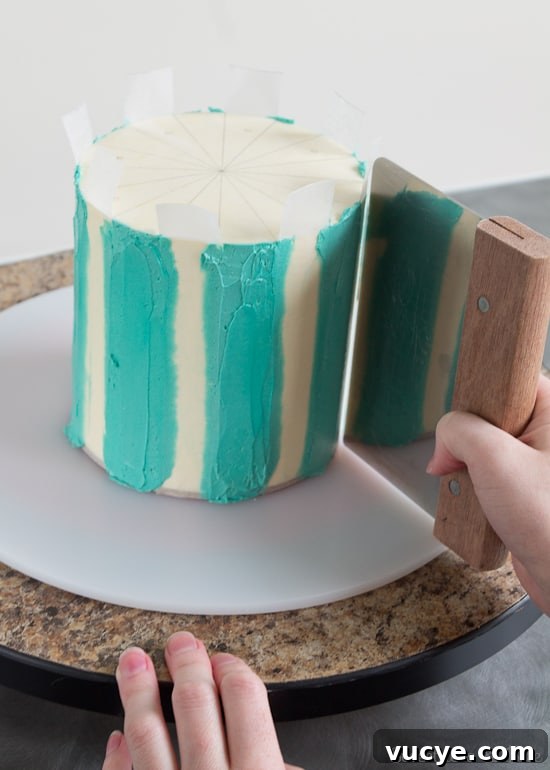
Use the spatula to push any excess buttercream along the top edge onto the waxed paper so the stripe tops are flat and smooth.
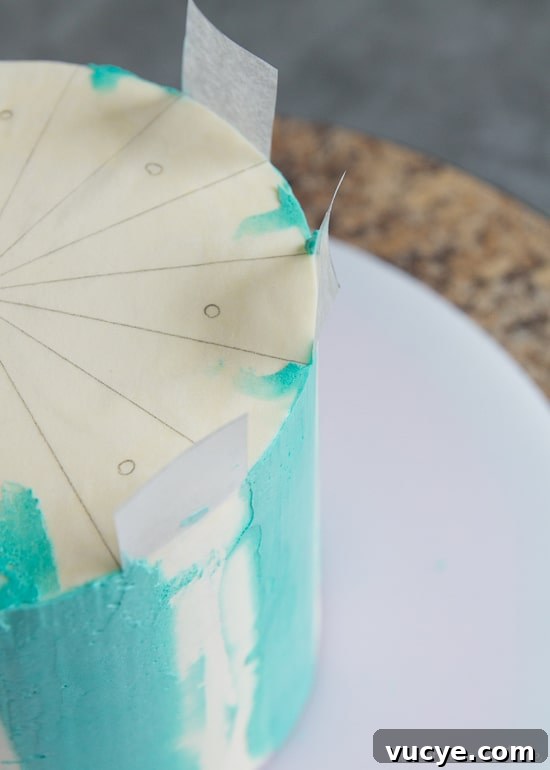
Chill the cake for about ten minutes so the stripes set, then carefully peel away the paper strips.
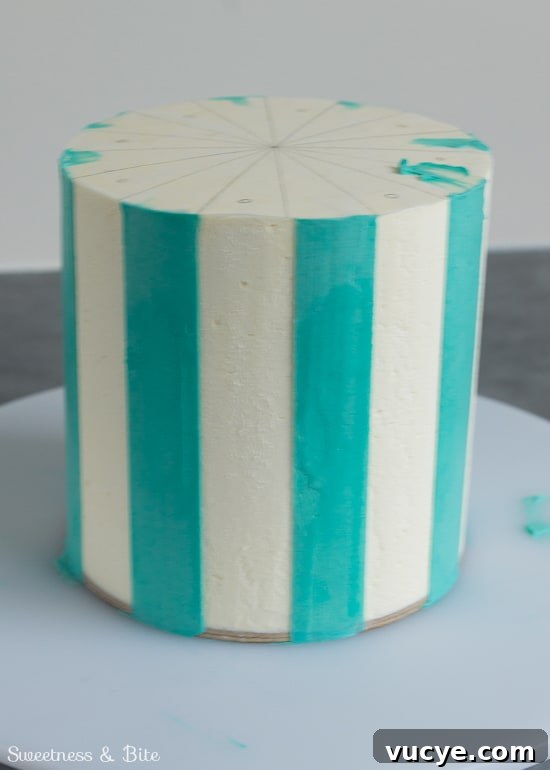
(Please excuse the blurry photo!)
Lift one edge of the top waxed circle with the spatula and peel it off. If any buttercream comes away with the paper, fill and resmooth those spots. Use the spatula tip to remove excess at the base of the stripes, or lightly wet your fingertip to gently smooth small rough areas.
If color has bled under the paper, a small artist palette knife or tiny spatula can gently scrape away the stray buttercream. For minor flaws, position that area at the back of the cake or disguise it with decorations.
Chill the cake again until the buttercream is firm before moving it to a cake board, stand, or stacking for a tiered cake.
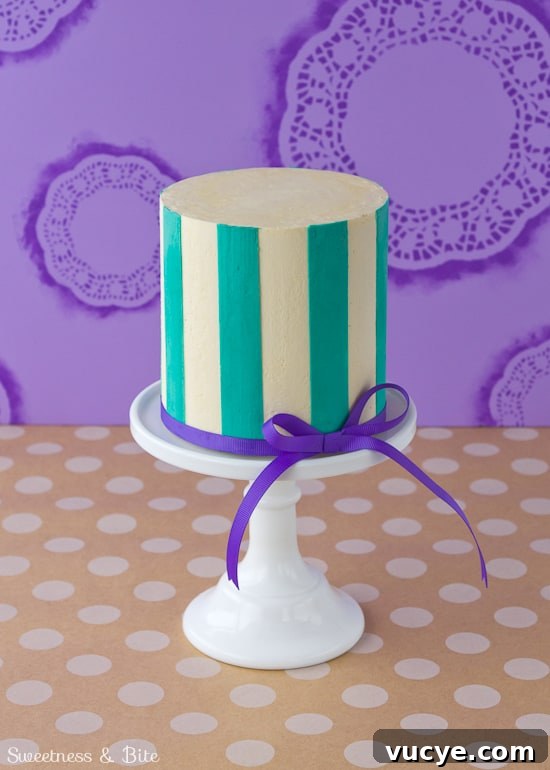
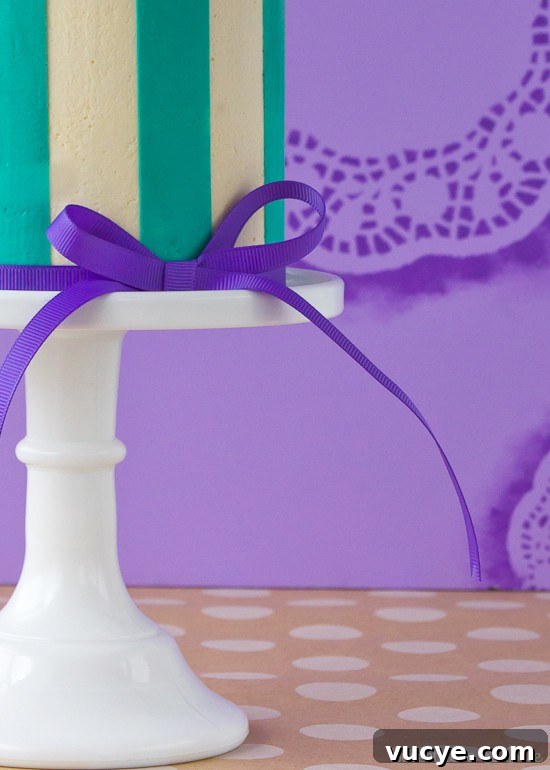
To hide the cake board, wrap ribbon around the base, overlapping at the back and securing with double-sided tape. Do this just before serving because buttercream fat can transfer to ribbon over time; if you need to prepare earlier, attach thin strips of waxed paper to the ribbon’s back with double-sided tape to prevent staining. I also tied a small ribbon bow and fixed it to the front with tape.
And there you have vertical buttercream stripes.
If you have questions, leave a comment and I’ll help where I can. ~Natalie
x